INTERIM ENGINEERING
RELATED SERVICE – SUSTAINABILITY
Industrial ORC Waste-Heat Recovery
The challenge
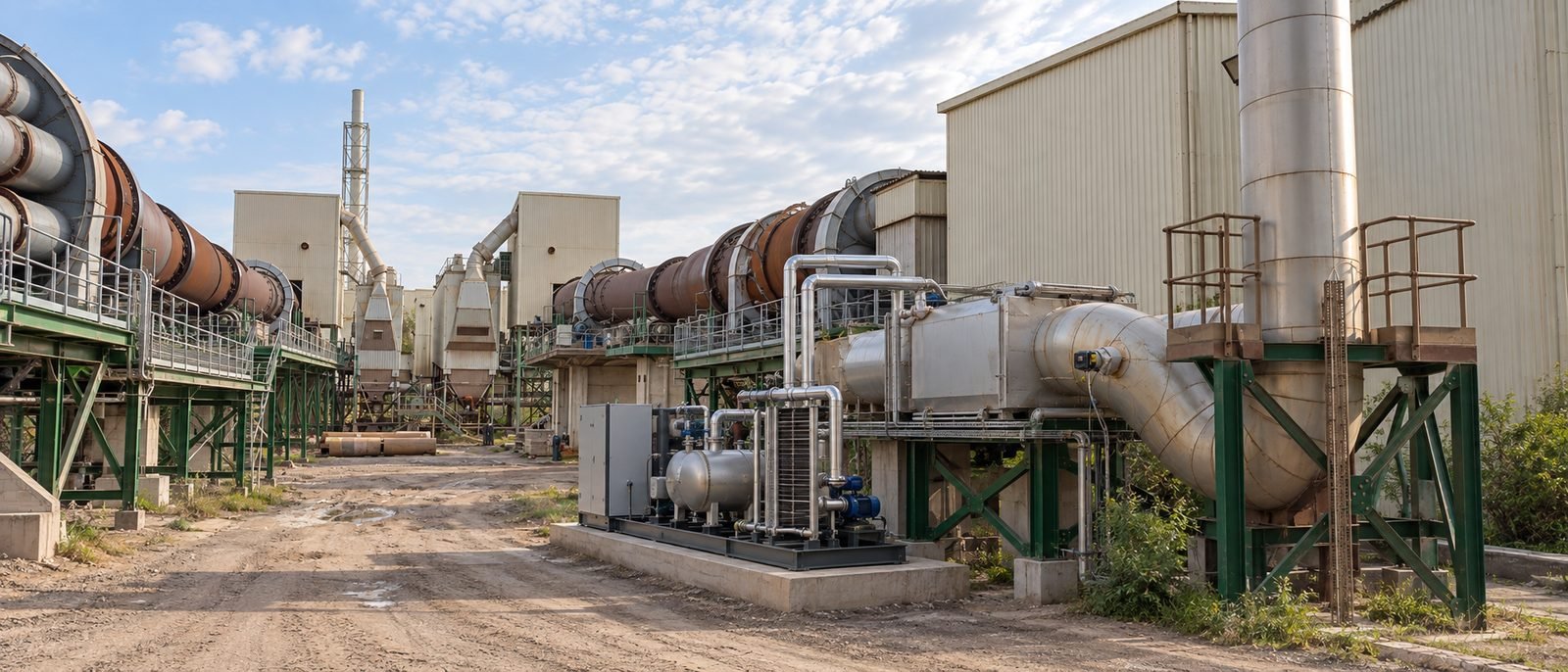
A continuous high-temperature manufacturing process was rejecting a significant quantity of energy through its kiln exhaust system.
The engineering challenge was not simply to determine whether an Organic Rankine Cycle could generate electricity. The study needed to establish whether sufficient recoverable and reliable thermal energy existed across actual operating conditions and whether a heat-recovery system could be integrated without adversely affecting kiln draft, exhaust-system pressure, process stability, emissions performance or plant availability.
The work was undertaken as an IETF-supported feasibility study, with the objective of moving the opportunity from an initial energy concept towards a technically defined and commercially assessable project. The government award was £36,797 against project costs of £53,994.
Sustainability Outcome
1.3 MWth engineered waste-heat recovery duty
£36.8k IETF government grant funding feasibility support
730 MWh/year potential on-site electricity generation
~96 tCO₂e/year potential Scope 2 carbon reduction
Establishing the Real Waste-Heat Optimisation
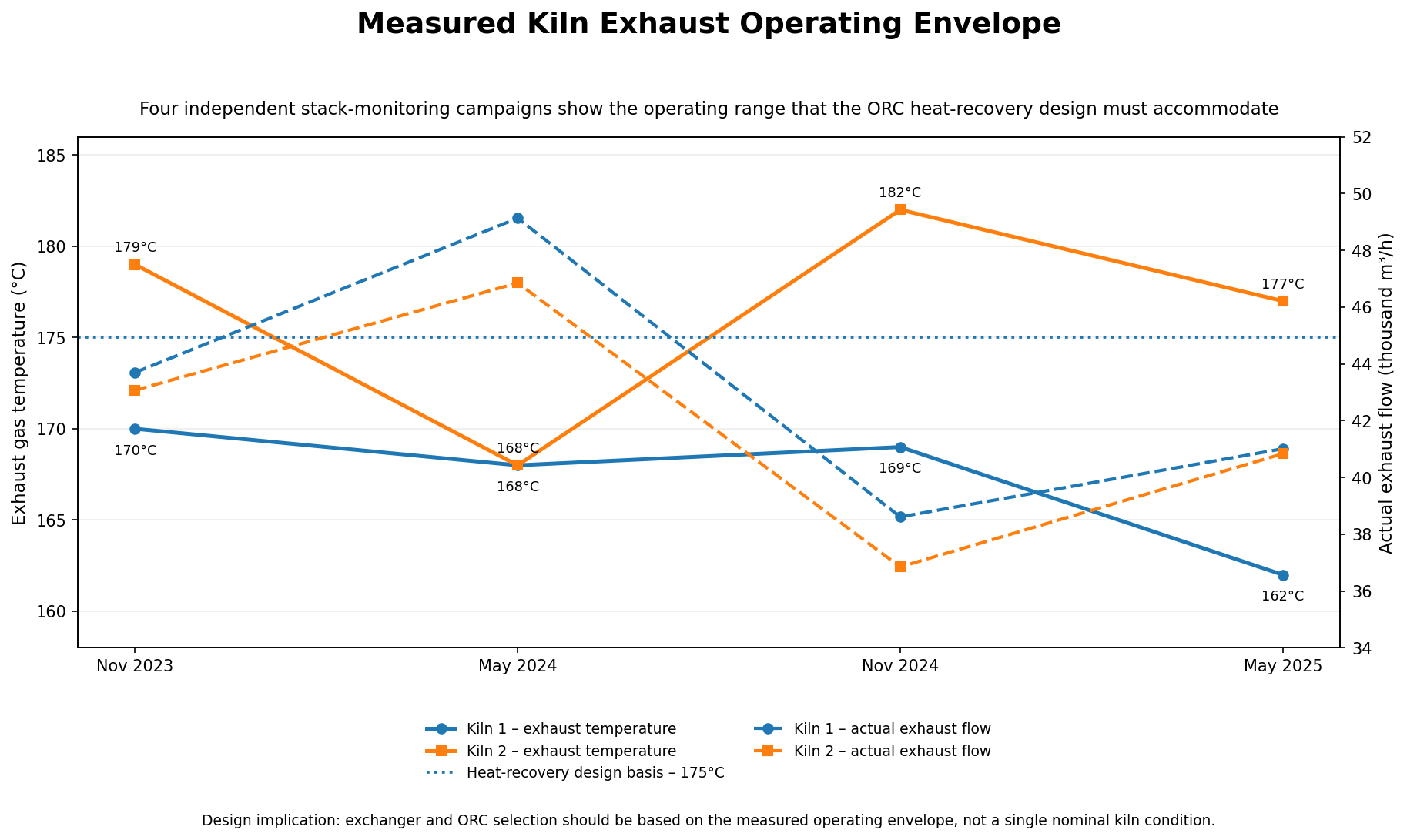
The assessment was based on measured operating data rather than nominal process assumptions.
Independent stack-monitoring campaigns covering both kiln exhaust streams demonstrated temperatures in the region of 162–182°C, with actual exhaust volumes varying from approximately 36,850 to 49,100 m³/h across the available operating records. For example, May 2025 monitoring recorded approximately 41,000 m³/h at 162°C on one kiln and 40,800 m³/h at 177°C on the second.
This variability was important because the ORC performance depends on the quantity, temperature and continuity of usable heat, so our engineering assessment considered the operating envelope rather than selecting equipment against a single peak condition.
More Than a Heat Balance
A credible industrial waste-heat project has to deal with the exhaust itself.
The stack data therefore included particulate loading, moisture, oxygen, sulphur dioxide, hydrogen chloride, hydrogen fluoride, NOx and other combustion parameters alongside temperature and flow. The measured composition varied between monitoring campaigns, making materials selection, corrosion risk, condensation control, fouling and cleaning access part of the engineering assessment rather than afterthoughts.
The proposed exchanger designs consequently used stainless grades including 316L/316Ti in critical gas-contact areas. Supplier maintenance requirements were also reviewed because exchanger performance can deteriorate through deposition and increased backpressure. The maintenance regime specifically requires monitoring of water quality, gas-side pressure drop, exchanger cleanliness and periodic internal inspection.
ORC Technology Assessment
Organic Rankine Cycle technology uses an organic working fluid with a lower boiling temperature than water, allowing lower-grade industrial heat to drive an expander and electrical generator.
For this project, technology selection was assessed in the context of proven industrial applications rather than as an emerging laboratory technology.
Operating cement-sector references include ORC waste-heat plants of approximately 2.3 MWe in Switzerland, 3.8 MWe and 4 MWe in Romania, 5 MWe in Slovakia and larger installations in Turkey.
These references demonstrated technical maturity, but their economics were not assumed to transfer directly to this application. Electrical conversion efficiency, annual generation and project return depend on available heat temperature, ORC scale, cooling arrangement, operating hours, parasitic loads and site integration.
That distinction is important: the feasibility work used established installations to validate the technology route while developing the site-specific engineering case independently.
Optioneering and Integration
The engineering study considered the project as a complete system rather than an isolated ORC package:
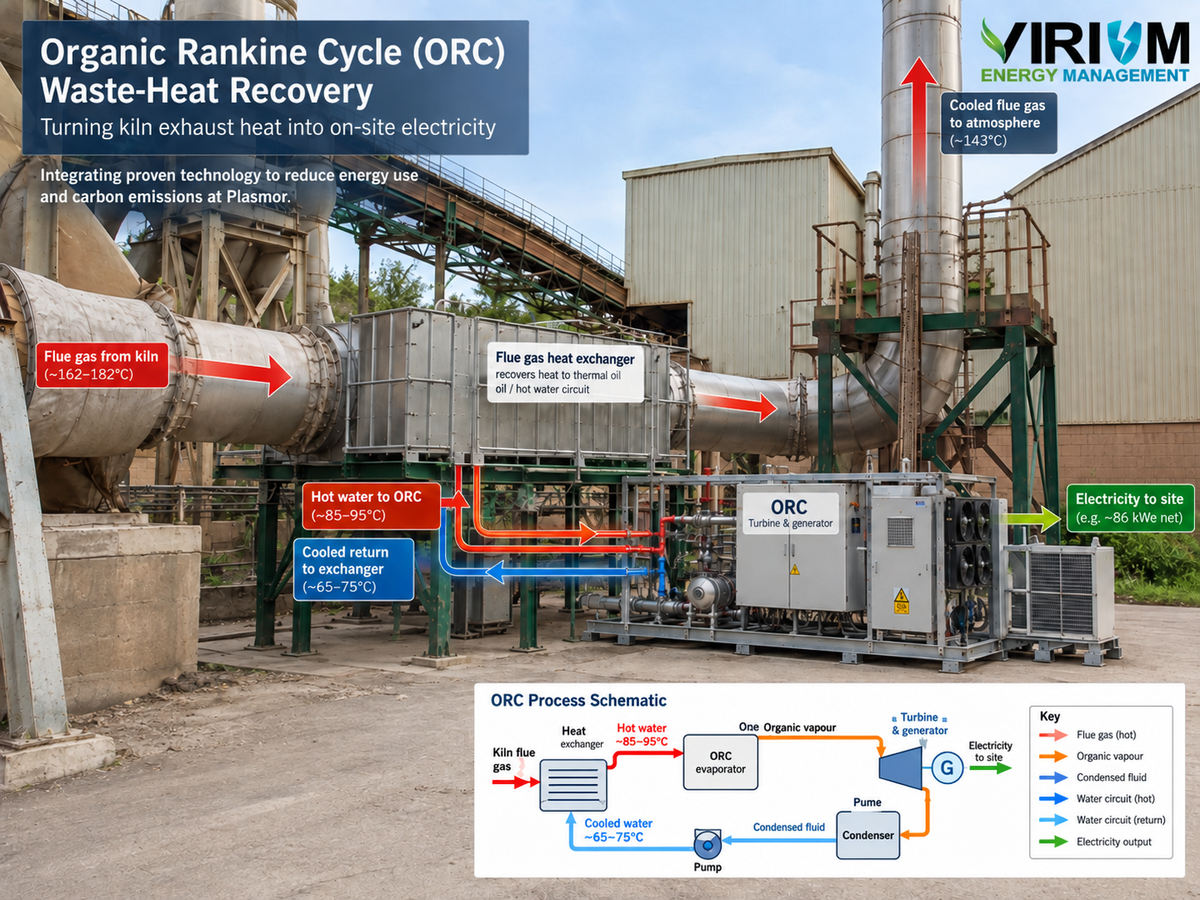
Kiln exhaust → heat-recovery exchanger → thermal transfer circuit → ORC evaporator/expander → generator → condenser → electrical integration
The evaluation addressed the trade-off between individual and combined heat recovery, exchanger size, pressure drop, operating flexibility, maintainability and the ability to isolate the energy-recovery plant without disrupting core production.
This is where the Interim Engineering element should be strongest. The work required coordination between plant operating data, environmental monitoring, specialist heat-exchanger suppliers, ORC technology providers and the client's investment requirements, converting separate technical inputs into one coherent project definition.
Virium Engineering Value
Virium brings together process understanding, operating data, energy engineering, specialist technology providers and commercial assessment to develop industrial decarbonisation opportunities around the realities of the live plant.
For waste-heat recovery, the objective is not simply to maximise theoretical energy capture. It is to define a solution that can operate reliably, maintain production, remain maintainable and deliver a credible business case through to implementation.
Engineering the Heat-Recovery System
The preferred concept separated the kiln exhaust from the ORC working fluid through an intermediate heat-recovery circuit.
Supplier development produced two principal exchanger arrangements:
Twin-stream arrangement: two exhaust-gas heat exchangers, each designed for approximately 664 kWth, recovering heat from gas entering at approximately 175°C and leaving at approximately 143°C. Each exchanger transferred energy into an 85/95°C water circuit and introduced a calculated gas-side pressure drop of approximately 14.6 mbar.
Combined arrangement: a larger common exchanger providing approximately 1,329 kWth of thermal recovery, based on approximately 135,720 kg/h wet exhaust flow, again cooling the gas from approximately 175°C to 143°C. The proposed water circuit was approximately 118 m³/h at 85/95°C, with an estimated gas-side pressure drop of 14.8 mbar.
This established an engineering basis of approximately 1.3 MWth recoverable process heat for further ORC development.
Investment & IETF Development
The engineering output was developed to support an investment decision rather than simply demonstrate that waste heat existed.
The IETF brief specifically required the feasibility work to identify realistic deliverables and obtain supplier proposals capable of moving the concept towards an executable project.
Supplier engagement therefore progressed far enough to establish equipment configuration, thermal duties, hydraulic requirements, materials, pressure losses, maintenance requirements and budgetary equipment information.
This allowed the client to assess the opportunity against:
technical viability • recoverable energy • electrical-generation potential • capital requirement • operational risk • maintainability • carbon benefit • investment return