SUSTAINABILITY
RELATED SERVICE – INTERIM ENGINEERING
Heat Pumps & Waste Heat Recovery
The challenge
A facility relied on a central gas-fired steam system to provide thermal energy for pasteurisation, three CIP systems, pasteuriser washing, tray washing and general hot-water demand.
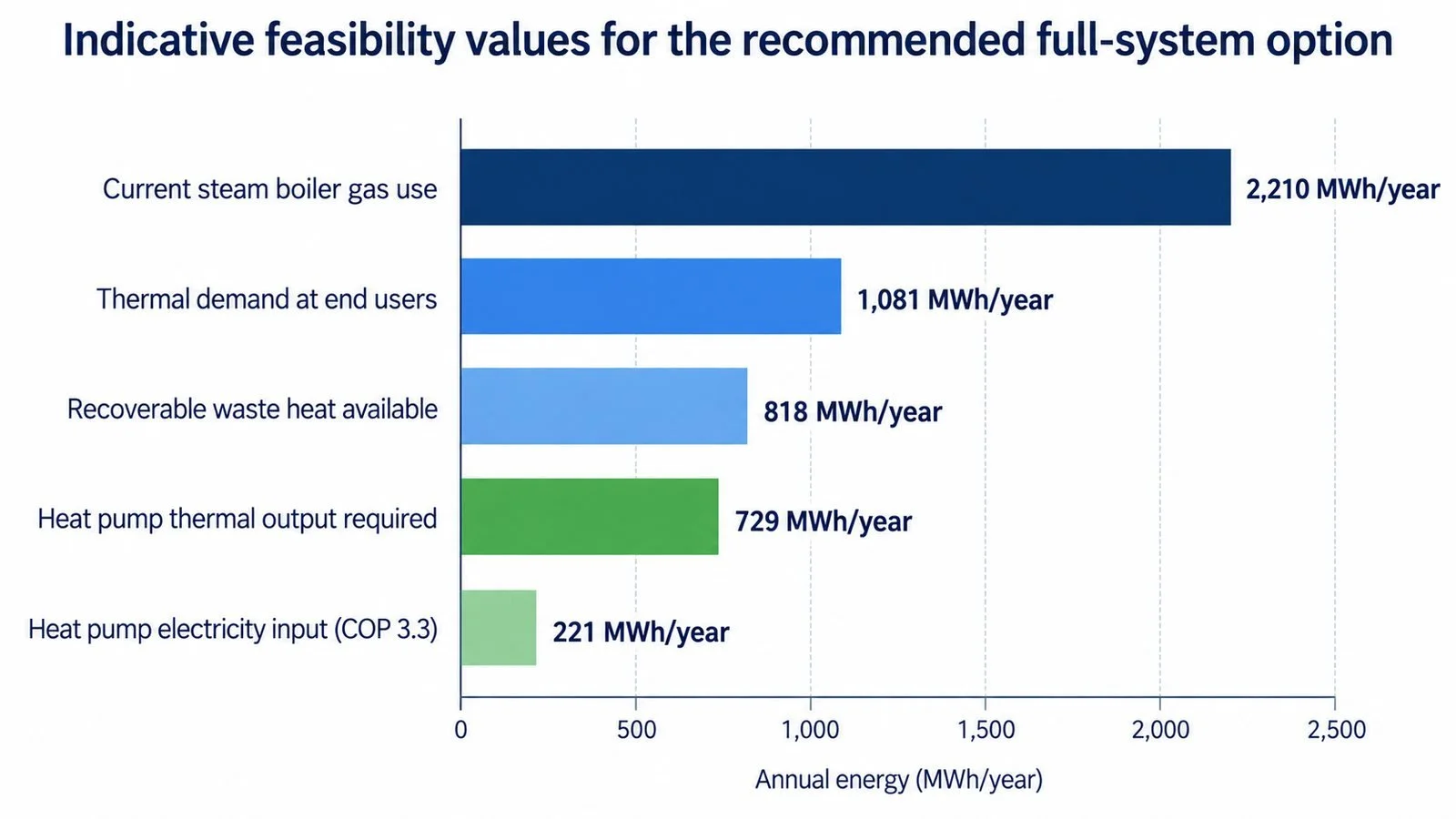
Most of these processes required hot water rather than steam, with operating temperatures ranging from approximately 45°C to 82°C. Analysis of the site energy data identified approximately 2,210 MWh/year of gas consumption associated with the steam system, creating a significant opportunity for electrification and carbon reduction.
The engineering challenge was not simply to replace the boiler with a heat pump. The solution had to accommodate varying process temperatures, high instantaneous thermal loads, different operating schedules and existing process interfaces, while remaining commercially viable and maintaining operational resilience.
At a glance
600 kW Recommended heat-pump capacity
Up to 82°C Process hot water
1,989 MkW/year Potential net energy saving
360 tCO₂e/year Potential carbon reduction
~£84k/year Estimated net operating cost saving
The engineering approach
Virium's engineering team analysed actual production and equipment data to establish the site's thermal-demand profile rather than sizing the heat pump from boiler capacity alone.
The assessment included pasteurisation loads, CIP heating and reheating cycles, pasteuriser washing, tray washing and general hot-water demand. Process schedules were reviewed to understand when loads occurred and where simultaneous demand would determine the required heat-pump capacity.
Particular attention was given to heat recovery. The site's refrigeration plant and compressed-air system were identified as significant sources of otherwise rejected thermal energy.
The technical story
The original feasibility concept used a two-stage cascade heat pump to achieve the large temperature lift required by the process. The proposed cascade arrangement combined an R290 air-source stage with an R600a water-source stage to raise water from approximately 10°C to 80°C.
During engineering development, the system was re-evaluated against an alternative high-temperature CO₂ heat-pump configuration. Instead of creating the entire temperature lift within the heat pump, recovered heat from the site's chillers and compressed-air system was used to preheat the incoming water.
This reduced the heat-pump inlet condition from approximately 10°C to 30°C, substantially reducing the required temperature lift before the heat pump raised the water to the process temperature.
The resulting single-stage CO₂ solution reduced estimated compressor demand from approximately 208 kW for the original cascade concept to 158 kW, while also simplifying the system and using a refrigerant with a lower global-warming potential.
Project outcome
The feasibility study demonstrated a technically viable route for replacing the site's gas-fired steam supply for the identified hot-water process loads with an integrated 600 kW high-temperature heat-pump and waste-heat-recovery system.
The preferred full-system option was estimated to deliver approximately 1,989 MWh/year of net energy saving, reduce carbon emissions by approximately 360 tCO₂e/year and provide around £84,000/year of net operating-cost saving.
Importantly, the engineering process improved the original concept. Integrating waste-heat recovery enabled the proposed cascade arrangement to be replaced by a simpler and more efficient single-stage CO₂ heat-pump solution.
The study provided the client with a technically developed basis for investment, grant assessment and progression into detailed design while maintaining existing steam infrastructure as operational backup.
Optioneering Approach
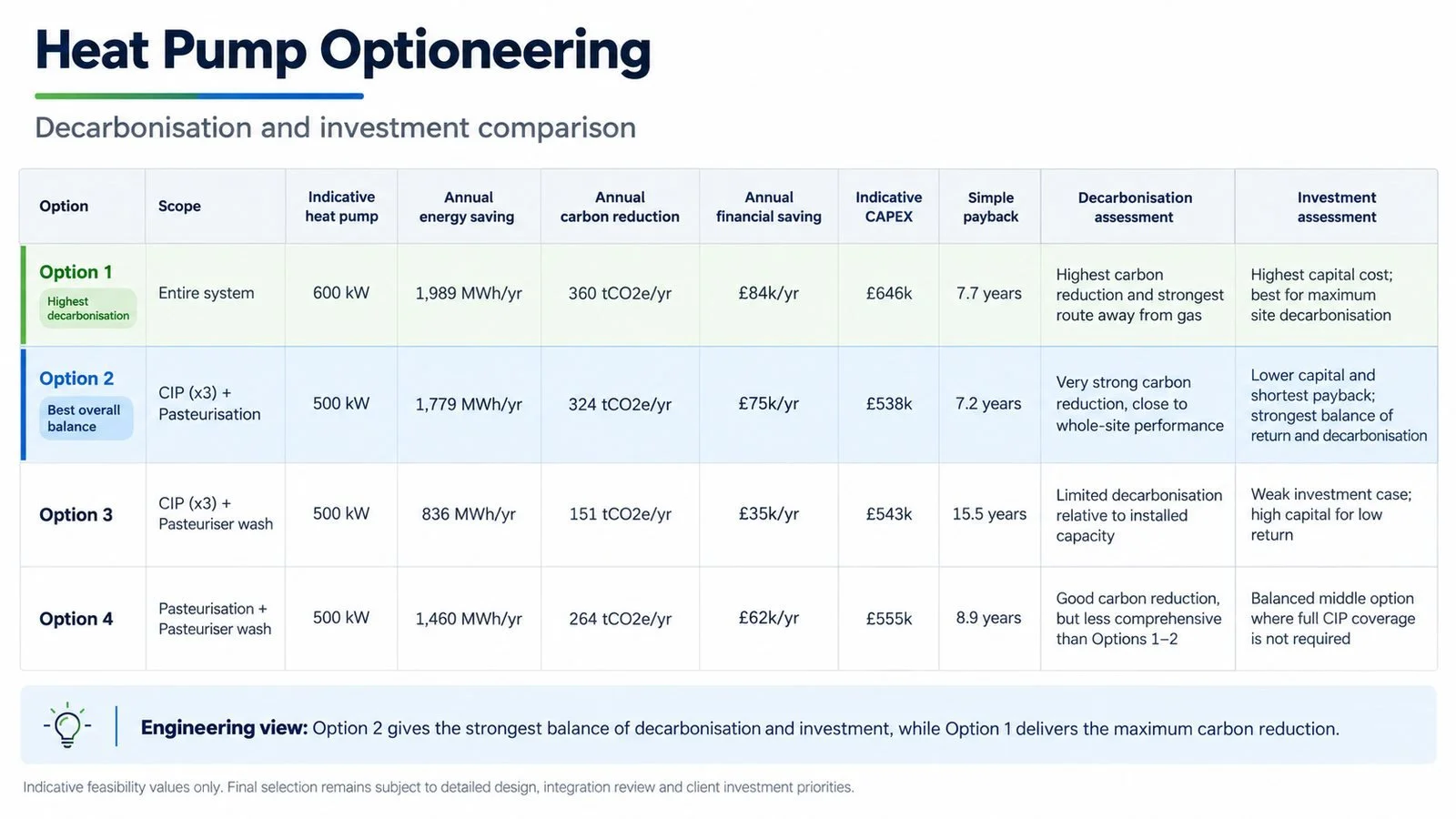
Four heat-pump configurations were assessed against thermal demand, waste-heat availability, installed capacity, energy saving, carbon reduction and capital return.
The purpose was to identify the point at which extending the electrification scope continued to deliver worthwhile decarbonisation without disproportionate additional investment.
The assessment identified Options 1 and 2 as the strongest overall cases, representing respectively the maximum decarbonisation route and the best balance of investment and performance.
Engineering around a live manufacturing site
The feasibility study extended beyond heat-pump selection to determine how the system could practically integrate with the operating factory.
Electrical capacity, equipment location, pipework routes, process heat exchangers, thermal storage, controls and maintenance resilience were assessed. A potential installation area approximately 12 m × 4 m was identified, together with high-level pipework routes connecting the heat pump, recovered-heat sources and process users.
The existing steam equipment was retained within the engineering strategy to provide resilience and maintenance backup rather than removing proven infrastructure immediately.